How to Import Flowers From Kenya: A Guide for International Buyers
August 24, 202612 min read

Contents
- Key Takeaways
- Why International Buyers Source Flowers From Kenya
- What International Buyers Typically Source From Kenya
- How Buyers Typically Find Kenyan Suppliers
- How to Evaluate a Kenyan Flower Exporter
- How to Specify What You Need
- Stem Length, Grade and Bloom Size
- Quantity, MOQ and Packaging Considerations
- Availability and Seasonality
- Quality Control: Harvest, Hydration and Cold Chain
- Export Preparation and Packaging
- Phytosanitary Considerations and Export Documentation
- Air Freight and the JKIA Export Process
- Destination Handling and Import Considerations
- Lead Time, Pricing and Payment Considerations
- Common Mistakes International Buyers Make
- How Buyers Can Reduce Risk
- What to Include in Your Request for Quotation (RFQ)
- How TrueScent Can Assist
- Frequently Asked Questions
- Related Reading
Kenya is one of the world's most established origins for fresh-cut flowers, supplying wholesalers, importers, florists and retailers across Europe, the Middle East, Asia and beyond. But importing from a new origin for the first time — or evaluating a new Kenyan supplier alongside an existing one — raises a lot of practical questions: what to buy, how to specify it, what a fair process looks like, and what can go wrong along the way.
This guide walks through the full journey, from understanding why buyers source from Kenya in the first place through to placing a well-specified order and receiving your shipment.
Key Takeaways
- Kenya's high-altitude, equatorial growing regions produce strong-stemmed, saturated-colour flowers with a reputation built over decades of commercial export.
- A good specification — variety, colour, stem length, grade, quantity, packaging, destination and date — is the single biggest factor in getting an accurate quote and a shipment that matches expectations.
- Availability is real and changes with season, weather and grower supply — treat any supplier who claims everything is "always available" with caution.
- Cold chain continuity from harvest to destination, not growing conditions alone, determines how much vase life actually survives the journey.
- Documentation (phytosanitary certificate, commercial invoice, packing list) and destination import requirements should be confirmed before your first order, not after the shipment has left Nairobi.
Why International Buyers Source Flowers From Kenya
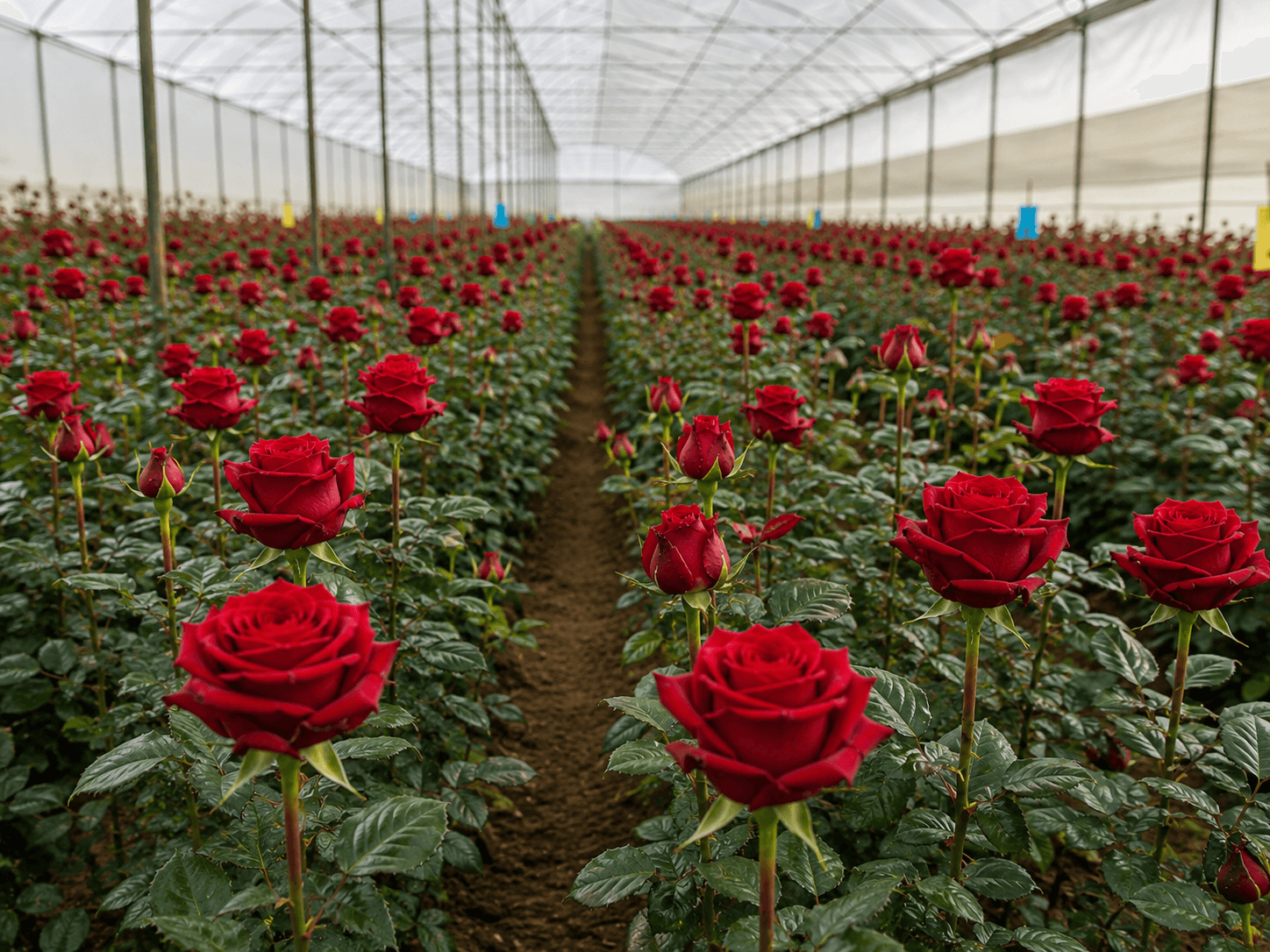
Kenya's position as a major cut-flower origin is not an accident of marketing — it comes down to a specific combination of geography and decades of industry build-out. Much of the country's flower production sits at elevations between roughly 1,500 and 2,500 metres above sea level, close to the equator. That combination gives growing regions near-constant day length through the year, intense equatorial sunlight, and cool overnight temperatures that slow plant respiration. The practical result is stems that grow strong and straight, blooms with deep, saturated colour, and flowers that hold up well once cut.
On top of the natural growing advantage, Kenya has built a mature horticultural export ecosystem: experienced growers and grading teams, established post-harvest and cold-chain practices, and a cargo infrastructure at Nairobi's Jomo Kenyatta International Airport (JKIA) that is set up specifically to move fresh, perishable cargo quickly. That combination — natural growing conditions plus export infrastructure — is why Kenyan flowers, and Kenyan roses in particular, are used as a quality benchmark in international flower trade. See Why Kenya for the fuller climate and geography picture.
What International Buyers Typically Source From Kenya
Kenyan farms grow a genuinely wide commercial range, not just roses. The main categories buyers source are:
- Single-head roses — one full bloom per stem, the classic wholesale rose format and Kenya's largest single export category.
- Spray roses — multiple smaller blooms branching from one stem, used for texture and volume in mixed arrangements.
- Carnations (standard and spray) — durable, long-lasting stems valued for resilience in transit.
- Summer and filler flowers — alstroemeria, gypsophila, hypericum, mathiola, limonium and statice among them, adding colour range and longevity to bouquets.
- Specialty flowers — agapanthus, amaryllis, eustoma (lisianthus), delphinium, hydrangea and gerbera daisy.
- Foliage and greens — ruscus, ferns, eucalyptus and ornamental leaves used alongside focal blooms.
Roses remain the largest single export category by volume. See our Kenyan Roses guide for variety, colour, grade and buying detail specific to that category, or browse the full catalogue to see the current range.
How Buyers Typically Find Kenyan Suppliers
Most international buyers reach a Kenyan supplier through one of a few routes: direct outreach after researching exporters online, referrals from other buyers already importing from Kenya, or industry trade events and flower auctions where Kenyan-grown product is represented. Whichever route you take, the evaluation process afterward should look the same — a first conversation to establish what a supplier actually grows or sources, how they handle grading and cold chain, and whether they can speak specifically (not vaguely) about current availability.
How to Evaluate a Kenyan Flower Exporter
A credible exporter should be able to answer, specifically:
- What varieties, colours and grades are currently available, not just what's grown in general?
- How is quality controlled at each stage — harvest, grading, hydration, cold storage?
- What packaging and carton formats do they offer, and can they meet your destination's requirements?
- What export documentation do they prepare, and do they understand your destination's import requirements?
- What is their typical lead time from confirmed order to airport departure?
- Can they support a trial order before you commit to a recurring programme?
See our dedicated guide on how to choose a Kenyan flower supplier for a full due-diligence checklist.
How to Specify What You Need
The single biggest driver of a smooth import is a clear, complete specification. A vague request ("send your rose catalogue") takes longer to quote accurately and increases the chance of a mismatch on arrival. A well-formed specification covers:
| Specification | What to provide |
|---|---|
| Variety | Named variety where you have a preference, or "grower's recommendation" for the intended use |
| Colour | Specific colour or colour family (e.g. "red", or a named shade) |
| Stem length | Preferred range in centimetres (e.g. 50–60cm) |
| Grade | Any grade requirement relevant to your market's grading convention |
| Quantity | Stems or bunches, by variety/colour |
| Packaging | Carton type, bunching, sleeving or wrapping preference |
| Destination | City and airport, plus preferred delivery terms (EXW, FCA, CPT, CIP, DAP) |
| Required date | Target delivery date or recurring order frequency |
Stem Length, Grade and Bloom Size
Stem length is one of the primary grading criteria in the cut flower trade and is almost always specified in centimetre increments. Longer stems generally carry a premium and suit larger arrangements and events, while shorter stems suit cost-efficient retail bunches. Grade typically reflects a combination of stem length, bloom or head size, straightness and overall condition. Specify your preferred stem length range and any grade requirement when requesting a quote — see Understanding Flower Stem Lengths for a deeper look at how this affects both quality and price.
Quantity, MOQ and Packaging Considerations
Minimum order quantities vary by variety and are usually confirmed at the point of quotation, based on current farm capacity — there is no single industry-wide MOQ. Many first-time buyers start with a smaller trial order specifically to evaluate quality, communication and reliability before scaling into a recurring volume commitment. Packaging format (carton size, bunching, sleeving) also varies by flower type and destination requirement, and should be confirmed alongside your specification rather than assumed.
Availability and Seasonality
Kenya's equatorial climate supports production across most of the year for many varieties, but availability is not unlimited or guaranteed for every variety, colour and stem length at every moment. Weather, grower production cycles and demand all affect what is genuinely available on a given week. See Kenya Flower Seasons & Availability for how to think about this, and always ask your supplier to confirm current availability by named variety rather than accepting a blanket "always in stock" answer.
Quality Control: Harvest, Hydration and Cold Chain
Flowers are cut at a bloom stage calculated to allow them to open correctly after several days in transit, then hydrated and moved promptly into cold storage. This sequence — harvest timing, hydration, pre-cooling and cold storage — protects vase life before a stem is ever packed for export, and an unbroken cold chain from farm to destination is one of the biggest factors in how fresh a shipment arrives. Ask your supplier how temperature control is maintained at each handoff: grading, packing, airport transfer and air freight. See Flower Quality and Cold Chain for a full stage-by-stage explanation.
Export Preparation and Packaging
Export cartons are engineered to protect stems from physical damage while allowing enough airflow to prevent heat build-up inside a sealed box during transit — a genuine engineering trade-off, not just a box size choice. Packaging format (carton dimensions, stems per bunch, sleeving) varies by flower type and is usually confirmed at the point of quotation based on your destination and handling requirements. See How Fresh Flowers Are Packed for Export for more detail.
Phytosanitary Considerations and Export Documentation
Fresh flower shipments typically travel with a phytosanitary certificate, a commercial invoice and a packing list. Phytosanitary certification confirms the shipment has been inspected and meets plant health requirements for export — this is issued by the relevant Kenyan plant health authority ahead of departure. Exact documentation requirements can vary by destination country and, occasionally, by flower type, so confirm your specific requirements with your supplier and, where relevant, your own customs broker before your first order — not after the shipment is already moving.
Air Freight and the JKIA Export Process
Fresh flowers move almost exclusively by air freight given how time-sensitive they are — there is no practical alternative for cut flowers travelling internationally. Shipments move from the farm or consolidation point to Nairobi, through pre-cooling and cold storage at the airport, then onto scheduled cargo capacity to the destination market. Routing, available capacity and chargeable weight (volumetric vs. actual weight) all factor into planning a shipment. See Flower Air Freight From Kenya for what to expect at each stage of this process.
Destination Handling and Import Considerations
Once a shipment lands, how quickly it clears customs and returns to cold storage matters just as much as everything that happened before the flight — the cold chain clock keeps running on both ends. Import requirements (customs clearance, any destination-market phytosanitary checks) vary by country, so it's worth confirming with your own customs broker, ahead of your first shipment, what is required on your side and how quickly your facility can receive and cold-store an inbound shipment.
Lead Time, Pricing and Payment Considerations
Lead time from a confirmed order to airport departure depends on the variety, current farm capacity and your specification — ask your supplier for a realistic figure rather than assuming a fixed number applies to every order. Pricing in the cut flower trade is generally quoted per order rather than from a fixed public list, because cost genuinely depends on variety, grade, volume, packaging, season and destination logistics — be cautious of a supplier willing to quote a fixed price list sight unseen. Payment terms should be agreed and confirmed in writing as part of your commercial agreement before the first shipment is prepared.
Common Mistakes International Buyers Make
- Under-specifying the order — leaving grade, packaging or stem length open and then being surprised by what arrives.
- Treating documentation as an afterthought — not confirming destination import requirements until the shipment is already moving.
- Assuming year-round availability for varieties that are genuinely seasonal, then being caught out at short notice.
- Skipping supplier due diligence — not asking specific questions about cold chain, grading and export experience before committing to volume.
- Going straight to a large recurring order instead of starting with a trial shipment to confirm quality and service.
How Buyers Can Reduce Risk
Start with a trial order sized to genuinely test quality, packaging and communication rather than committing to a full programme immediately. Ask specific, checkable questions rather than accepting general reassurances (see the supplier-evaluation questions above). Confirm documentation and destination import requirements in writing before the first shipment. And build a relationship with a supplier who will tell you honestly when something isn't currently available, rather than one who says yes to everything.
What to Include in Your Request for Quotation (RFQ)
A well-formed RFQ should include: flower and variety, colour, quantity, stem length, grade (if relevant), packaging preference, destination country and airport, required delivery date or order frequency, and any additional requirements specific to your market. The more specific the brief, the more accurately a supplier can quote and the fewer surprises on arrival. Request a quote directly, or see our step-by-step buyer's guide for how the process works end to end.
How TrueScent Can Assist
TrueScent Flowers is a Kenyan flower sourcing and export business based at JKIA, Nairobi, with more than 30 million stems exported to international markets. We work with buyers to define a clear specification, confirm availability against current grower supply, and coordinate export documentation and air freight through to your destination — always on the basis that availability is subject to grower supply and buyer requirements at the time of the request.
Frequently Asked Questions
What documents do I need to import flowers from Kenya?
Fresh flower shipments typically travel with a phytosanitary certificate, commercial invoice and packing list. Exact documentation requirements vary by destination country, so confirm your specific requirements with your supplier and, where relevant, your customs broker before your first order.
Is there a minimum order quantity for a first import from Kenya?
Minimum order quantities vary by variety and are usually confirmed at the point of quotation, based on current farm capacity. Many buyers start with a smaller trial order to confirm quality and service before scaling into a recurring supply programme.
How do I know what flowers are actually available before I order?
Ask your supplier to confirm current availability by named variety, colour, stem length and grade rather than accepting a general "always in stock" answer — see Kenya Flower Seasons & Availability for why availability genuinely varies by variety and season.
Does TrueScent arrange air freight, or do I need my own freight forwarder?
TrueScent coordinates export documentation and air freight through to your destination as part of the export process. Buyers should still confirm their preferred destination airport and any customs or freight-handling requirements specific to their own market.
Can I place a trial order before committing to a recurring supply programme?
Yes. Starting with a smaller trial order is a reasonable way to evaluate quality, communication and reliability before moving to a recurring volume commitment.
How far in advance should I place my first order?
This depends on the variety and your destination, and is best confirmed directly with your supplier — lead times can vary with season and current farm capacity. As a general principle, the more advance notice you can give, especially for a first or larger-than-usual order, the more reliably a supplier can plan against it.
Related Reading
- Flower Export From Kenya: From Farm to International Buyer
- How to Choose a Kenyan Flower Supplier
- Wholesale Flower Buying Guide for International Buyers
- Flower Quality and Cold Chain
Ready to source Kenyan flowers? Request an Export Quote.
Ready to Source Kenyan Flowers?
Tell us your flower, specifications and destination — our export team will confirm availability.