

Contents
Packing is often thought of as the final, simple step before a shipment leaves the farm, but it's doing real protective work — and getting it wrong can undo careful handling earlier in the process. For a buyer, understanding what goes into export packaging also makes it much easier to specify what you actually need, rather than accepting a default you haven't thought through.
Key Takeaways
- Export packaging balances two competing requirements — physical protection and airflow — and getting that balance wrong can undo good handling everywhere else in the chain.
- Packaging format varies genuinely by flower type; there's no single universal carton standard across the whole catalogue.
- Grading always happens before packing, not after, since packing decisions depend on what's actually being packed.
- Packaging preference is a specification worth confirming explicitly, not left to a default, especially for buyers with retail-ready or event-specific needs.
Two Competing Requirements
Export cartons have to protect stems from physical damage — crushing, bending, bruising — during transit, while also allowing enough airflow to prevent heat build-up inside a sealed box. A carton packed too tightly for protection can trap heat and accelerate deterioration; one packed too loosely risks stems shifting and damaging each other in transit. Every export packing decision is, at some level, a negotiation between these two requirements, and getting the balance right is what separates competent export packing from packing that merely looks neat.
Standard Formats
Packaging format varies by flower type. Roses are typically bunched into a set stem count — 20 or 25 stems per bunch is common — sleeved for protection, and packed into standard export cartons. Carnations and many filler flowers follow similar bunch-and-carton formats, sized to the flower's own stem strength and bloom fragility. More delicate specialty flowers may require additional internal protection or different carton dimensions altogether, reflecting their specific fragility and stem characteristics.
Carton Requirements
A well-designed export carton needs: sufficient ventilation (typically vent holes positioned to allow airflow without compromising structural strength), internal support to prevent stems shifting during handling and transit, dimensions matched to the specific flower and bunch format being packed, and enough structural rigidity to stack safely during consolidation and cargo handling without crushing the cartons beneath.
Grading Before Packing, Not After
Stems are graded — for length, bloom size and overall condition — before packing, not after, since packing decisions (bunch size, carton dimensions) depend on what's actually being packed. This is also the last quality checkpoint before a shipment is sealed for transit — once a carton is packed and sealed, correcting a grading error becomes far more disruptive than catching it beforehand.
Packaging and the Cold Chain
Packaging isn't separate from cold-chain management — it's part of it. A carton's ventilation design directly affects how well cold air can circulate around the stems inside it during cold storage and transit, which is why packaging and temperature control are planned together rather than treated as separate concerns. See Flower Quality and Cold Chain for how these pieces fit together.
What Buyers Can Specify
Most buyers use standard export packaging by default, but packaging preference is one of the specifications worth confirming at the point of quotation, particularly for buyers with specific retail-ready or event-specific packaging needs. This can include bunch size, sleeving type, carton branding or labelling requirements, and any destination-specific packaging regulations you're aware of. See our Wholesale Flowers page for the full list of what to specify when ordering, or the Export Process page for how packing fits into the wider journey from farm to airport.
Frequently Asked Questions
Why can't export cartons just be packed as tightly as possible for protection?
Packing too tightly can trap heat inside the box, since export cartons also need enough airflow to prevent heat build-up during transit. Packing too loosely, on the other hand, risks stems shifting and damaging each other. Getting the balance right is the point of a proper export packing format.
How many stems come in a typical rose bunch?
Roses are typically bunched into a set stem count — 20 or 25 stems per bunch is common — then sleeved for protection and packed into standard export cartons.
Can I request retail-ready packaging for my order?
Yes — packaging preference, including retail-ready or event-specific formats, is worth confirming at the point of quotation, since most orders use standard export packaging by default.
Is grading done before or after packing?
Before. Stems are graded for length, bloom size and overall condition before packing, since packing decisions like bunch size and carton dimensions depend on what's actually being packed.
Do all flower types use the same packaging format?
No — packaging format varies by flower type. Roses and carnations typically follow bunch-and-carton formats, while other filler flowers use formats sized to their own stem strength and bloom fragility.
Does packaging affect cold-chain performance?
Yes. A carton's ventilation design directly affects how well cold air can circulate around the stems inside during cold storage and transit, which is why packaging and temperature control are planned together rather than as separate concerns.
Related Reading
Ready to specify your packaging requirements? Request an Export Quote.
Ready to Source Kenyan Flowers?
Tell us your flower, specifications and destination — our export team will confirm availability.
Related Articles
Quality & LogisticsSeptember 20267 min read
Flower Air Freight From Kenya: What International Buyers Should Know
Why fresh flowers travel by air, how Nairobi's cargo infrastructure supports the trade, and what information buyers should provide when requesting freight-inclusive pricing.
Read article →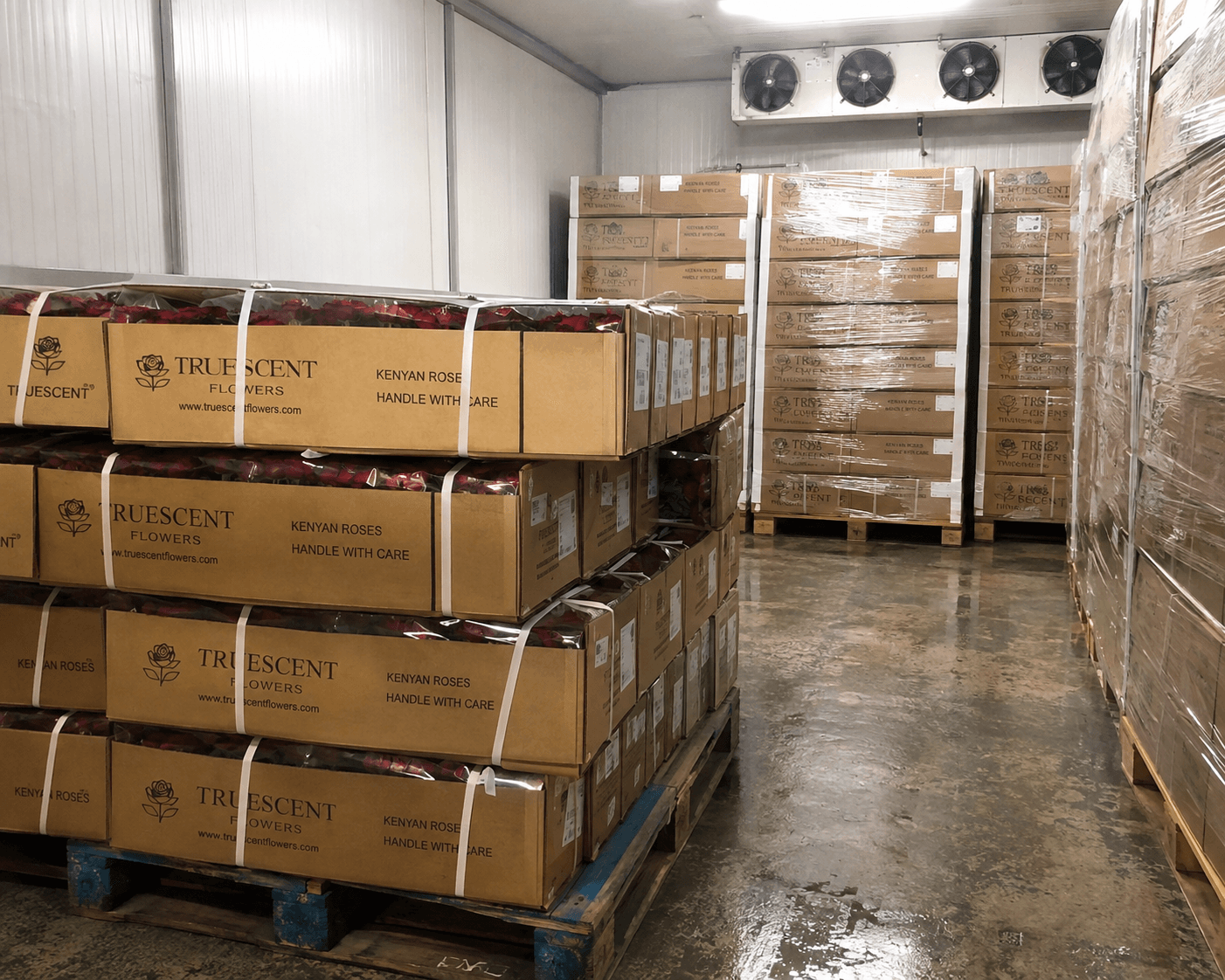
Quality & LogisticsSeptember 20268 min read
Flower Quality and Cold Chain: From Kenyan Farm to International Buyer
Why temperature control is the single biggest factor in flower freshness, and how it's maintained at every stage from Kenyan farm to international buyer.
Read article →Quality & LogisticsAugust 20265 min read
How to Maintain Freshness During Flower Transportation
From harvest to delivery, several handling steps determine how fresh flowers arrive at their destination.
Read article →