
Flower Quality and Cold Chain: From Kenyan Farm to International Buyer
September 10, 20268 min read
Contents
- Key Takeaways
- Why Temperature Matters
- The Cold Chain, Stage by Stage
- Harvest Timing
- Hydration
- Grading
- Pre-Cooling
- Cold Storage
- Packaging
- Handling and Handoffs
- Airport Transfer
- Air Freight
- Destination Handling
- Vase-Life Implications of a Broken Cold Chain
- What Buyers Should Look For in a Supplier
- Frequently Asked Questions
- Related Reading
"Cold chain" is one of the most-used terms in flower export — and one of the least explained. It's worth being specific about what it actually means, why it matters as much as it does, and what a buyer should actually listen for when a supplier says they "maintain the cold chain." This is intended as a practical, educational look at the process, not a promotional claim.
Key Takeaways
- Cut flowers are living tissue after harvest — they keep respiring, which is what temperature control is actually slowing down.
- A cold chain is only as strong as its weakest handoff — near-perfect handling everywhere except one short gap can still cost meaningful vase life.
- The cut-flower industry generally holds flowers in the 2–4°C range from grading through to air freight; consistency across every handoff matters more than the exact number.
- The right question to ask a supplier isn't "do you maintain the cold chain" but "how, specifically, at each handoff."
Why Temperature Matters
Cut flowers are still living tissue after harvest — they continue to respire, consuming stored energy and losing water even after being cut. Higher temperatures accelerate this process significantly, which is why flowers held at ambient tropical temperatures deteriorate far faster than the same flowers held in cold storage. Slowing respiration through temperature control is, in a real sense, the entire purpose of everything described below — every other stage exists either to prepare a stem for cold storage or to protect it once it's there.
The Cold Chain, Stage by Stage
| Stage | What happens | Purpose |
|---|---|---|
| Harvest timing | Stems cut at a calculated bloom stage | Sets up correct opening over the following days, not peak bloom immediately |
| Hydration | Stems placed in a hydrating solution | Rebuilds water pressure lost during cutting |
| Grading | Sorted in a temperature-controlled environment | Protects stems while applying the last quality checkpoint before packing |
| Pre-cooling | Stems brought down to storage temperature | Prevents packing warm stems into a sealed carton, which traps heat |
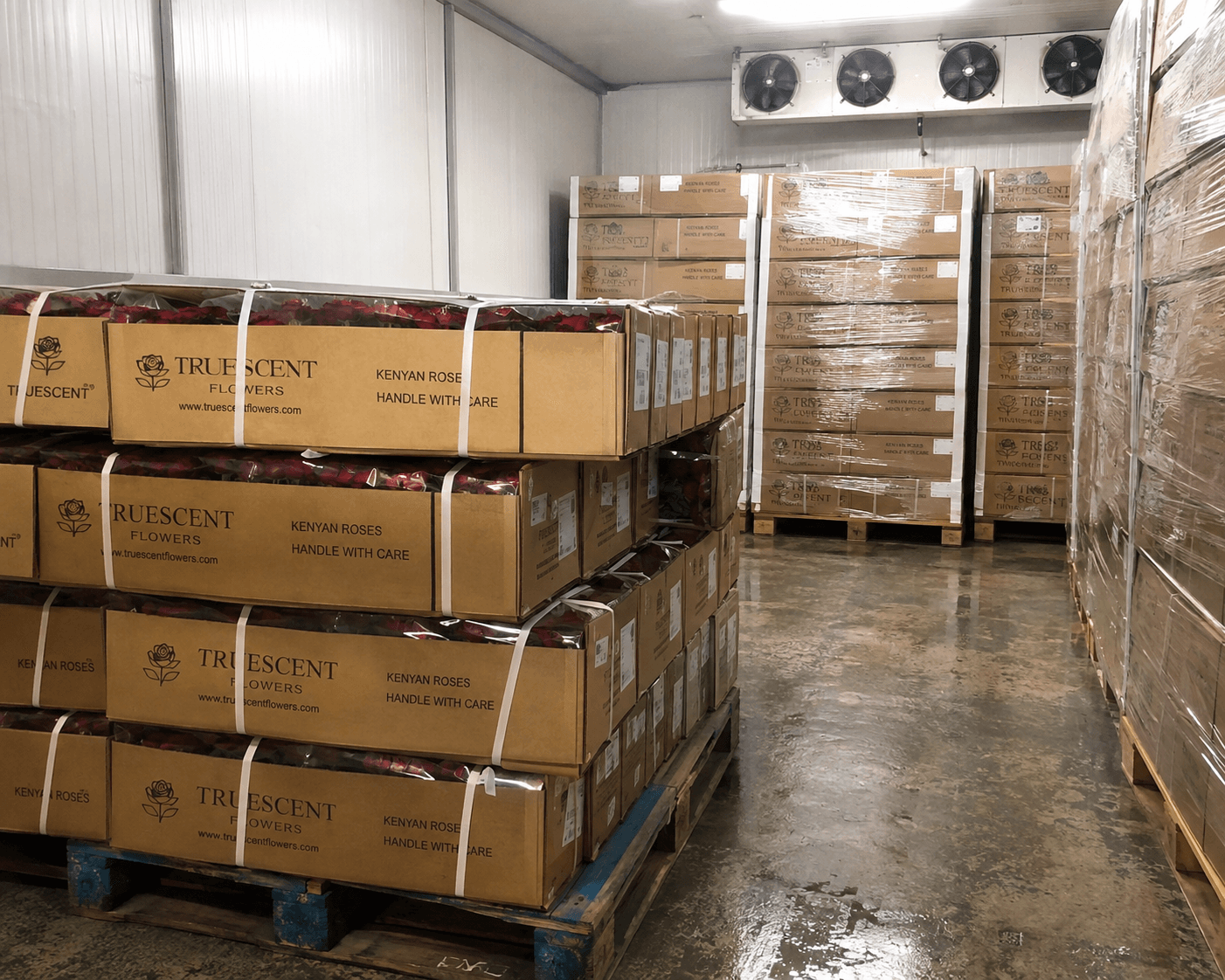
| Cold storage | Temperature-controlled holding ahead of packing | Slows respiration, buying time between harvest and export |
| Packing | Bunched and cartoned for airflow and protection | Balances physical protection against heat build-up in a sealed box |
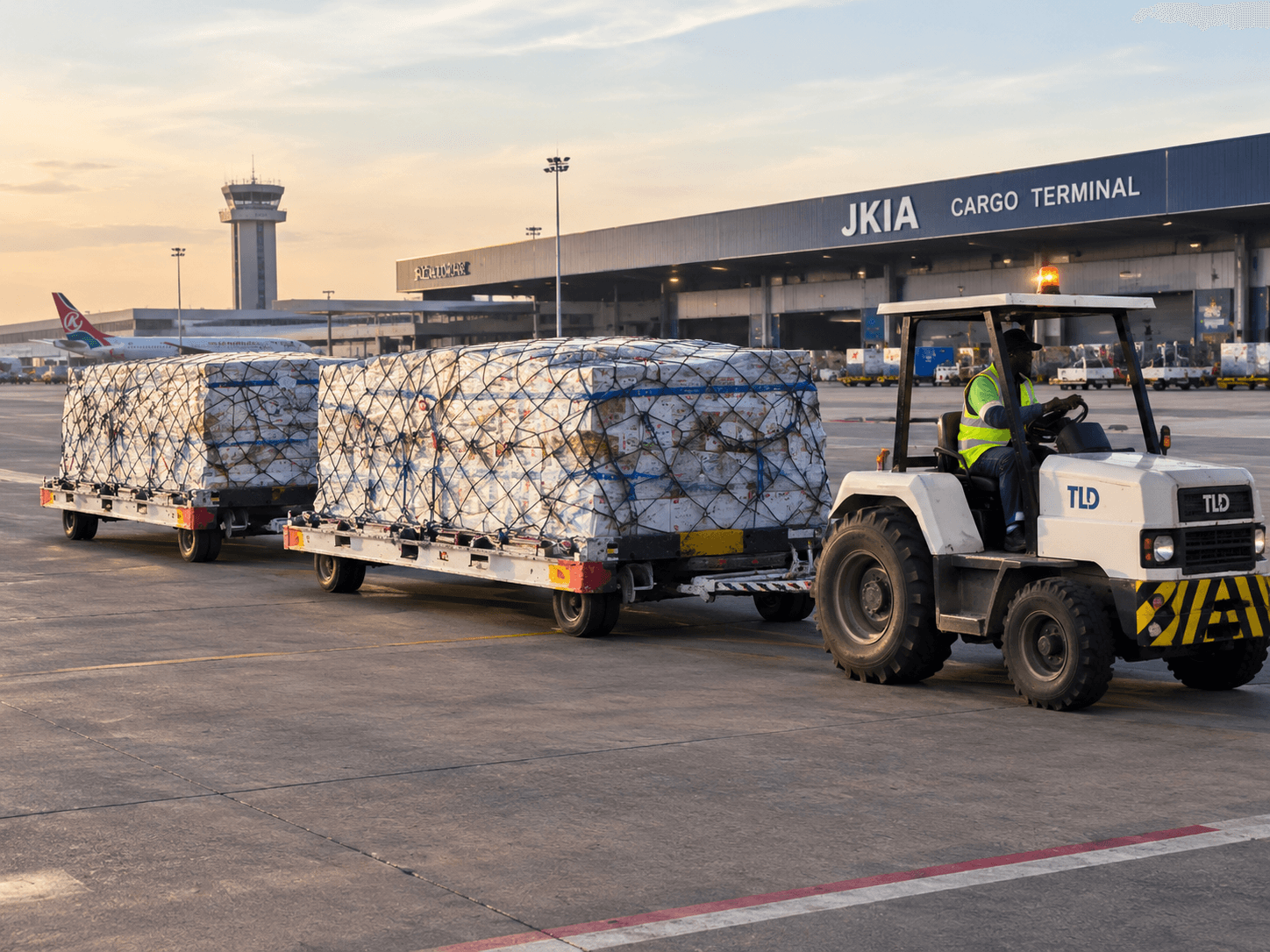
| Airport transfer | Moved to JKIA under cold conditions | Minimises time outside temperature control before the flight |
| Air freight | Temperature-controlled cargo handling where available | Continues protection through the highest-risk leg of the journey |
| Destination handling | Fast customs clearance, prompt return to cold storage | The cold chain clock keeps running once flowers land |
Harvest Timing
Flowers are cut at a bloom stage calculated to allow them to open correctly after several days in transit, rather than at peak bloom, which would shorten usable vase life after arrival. This decision is variety-specific and is one of the clearest markers of grower experience — cut too early and a bloom may never open properly; cut too late and it may not survive the journey at all.
Hydration
Immediately after harvest, stems are placed in a hydrating solution to rebuild water pressure lost during cutting, before moving into cold storage. A poorly hydrated stem going into cold storage starts the entire cold chain at a disadvantage that later stages can't fully correct.
Grading
Grading takes place in a temperature-controlled environment, both to protect the stems and because it's the last quality checkpoint before packing — this is where stem length, bloom size and overall condition are confirmed against the specification a buyer has ordered.
Pre-Cooling
Stems are brought down to storage temperature before packing, since packing warm stems into a sealed carton traps heat rather than dissipating it. Skipping or rushing pre-cooling is a common, hard-to-spot failure point, because the carton looks correctly packed even though the flowers inside are still cooling down — and generating heat — after the box is sealed.
Cold Storage
Temperature-controlled storage ahead of packing slows respiration and preserves freshness, buying time between harvest and export without meaningfully shortening vase life. This is the stage that gives an exporter flexibility to consolidate a shipment or wait for a specific flight, without the flowers ageing as if they were sitting at ambient temperature.
Packaging
Export cartons need to protect stems from physical damage while allowing enough airflow to prevent heat build-up inside a sealed box — a genuine engineering trade-off, not just a box size choice. See How Fresh Flowers Are Packed for Export for how this is handled in practice.
Handling and Handoffs
Every handoff — grading to packing, packing to transport, transport to airport — is a point where temperature control can lapse if it isn't actively managed. Handoffs, not the storage stages themselves, are where cold chains most commonly break, simply because each one involves a change of custody, a change of environment, or both, in a short window of time.
Airport Transfer
Cartons move to the airport under cold chain conditions, with timing coordinated to minimise time spent outside temperature control before the flight. This is one of the reasons harvest, grading and packing schedules are planned backward from a specific flight rather than forward from harvest — every stage exists to land the shipment at the airport, cold, exactly when it's needed.
Air Freight
Temperature-controlled cargo handling continues through air freight where available — see Flower Air Freight From Kenya for more on this stage, including what can affect quality during transportation itself.
Destination Handling
On arrival, fast customs clearance and a prompt return to cold storage are just as important as everything that happened before the flight, since the cold chain clock keeps running once flowers land. A buyer with cold storage ready to receive a shipment immediately preserves meaningfully more vase life than one who leaves flowers sitting at ambient temperature while customs and transport are arranged after the fact.
Vase-Life Implications of a Broken Cold Chain
A cold chain is only as good as its weakest link. A flower can spend 95% of its journey in perfect temperature control and still lose meaningful vase life from one short break — a warm tarmac wait, a delayed cold-storage handoff, a customs delay without refrigeration. The damage from a cold-chain break is often not visible immediately; it shows up later as a shorter-than-expected vase life, which is part of why cold chain discipline matters even when nothing looks visibly wrong on arrival.
What Buyers Should Look For in a Supplier
- A specific, stage-by-stage description of how temperature control is maintained — not just an assurance that "freshness is guaranteed."
- Clarity about where handoffs happen and how they're managed (farm to transport, transport to airport, airport to aircraft).
- Evidence of pre-cooling as a distinct step, not an assumption that cold storage alone handles it.
- A plan for destination handling — fast clearance and prompt return to cold storage — not just responsibility for the flight itself.
If cold chain integrity matters to your order — and it should, for any fresh flower purchase — it's reasonable to ask a supplier how they maintain temperature control at each handoff point rather than accepting "we maintain the cold chain" as a complete answer. See our Export Process page for how this works stage by stage, or Quality & Sustainability for more on grading and hydration.
Frequently Asked Questions
What temperature range is used for cold chain flower storage?
The cut-flower industry generally holds flowers in the 2-4°C range from grading through to air freight. Consistency matters more than the exact number — every break in that range, even briefly, shortens vase life.
Why does even a brief break in the cold chain matter so much?
A cold chain is only as good as its weakest link. A flower can spend most of its journey in perfect temperature control and still lose meaningful vase life from one short break, such as a warm tarmac wait or a delayed cold-storage handoff.
At what stage does cold chain handling actually begin?
Immediately after harvest. Stems are hydrated to rebuild water pressure lost during cutting, then moved into cold storage before grading, packing and airport transfer all continue under temperature control.
Does the cold chain continue once flowers are in the air?
Temperature-controlled cargo handling continues through air freight where available. See Flower Air Freight From Kenya for more on that stage specifically.
What certifications support TrueScent's quality and cold chain process?
TrueScent Flowers exports under KEPHIS phytosanitary certification and is a member of the Kenya Flower Council (KFC). Contact our export team for current documentation relevant to your order.
Related Reading
- Flower Export From Kenya: From Farm to International Buyer
- How Fresh Flowers Are Packed for Export
- Flower Air Freight From Kenya
Ready to source with confidence? Request an Export Quote.
Ready to Source Kenyan Flowers?
Tell us your flower, specifications and destination — our export team will confirm availability.
Related Articles
Quality & LogisticsSeptember 20267 min read
Flower Air Freight From Kenya: What International Buyers Should Know
Why fresh flowers travel by air, how Nairobi's cargo infrastructure supports the trade, and what information buyers should provide when requesting freight-inclusive pricing.
Read article →
Quality & LogisticsSeptember 20264 min read
How Fresh Flowers Are Packed for Export
Export packaging has to do two competing jobs at once — protect stems from damage and keep air moving to prevent heat build-up.
Read article →Quality & LogisticsAugust 20265 min read
How to Maintain Freshness During Flower Transportation
From harvest to delivery, several handling steps determine how fresh flowers arrive at their destination.
Read article →