
Flower Air Freight From Kenya: What International Buyers Should Know
September 10, 20267 min read
Contents
- Key Takeaways
- Why Fresh Flowers Are Transported by Air
- Nairobi and JKIA as an Export Origin
- Why Timing Is Everything
- Cargo Preparation and Handover
- Packaging for Air Cargo
- Cold-Chain Continuity Through the Airport and Flight
- Transit and Routing Considerations
- Factors That Affect Freight Cost
- Factors That Can Affect Flower Quality During Transportation
- Importer Preparation at Destination
- What Information to Provide When Requesting Freight-Inclusive Pricing
- Frequently Asked Questions
- Related Reading
Fresh flowers are perishable from the moment they're cut, which is why nearly all international flower trade — Kenya's included — moves by air rather than sea. For a buyer who has never planned a flower import before, understanding how this leg of the journey actually works helps explain both the cost structure and the quality outcome you should expect on arrival.
Key Takeaways
- Air freight exists because flowers have a vase life measured in days, not weeks — sea freight transit times simply don't fit that window.
- JKIA's cargo infrastructure is built specifically around fast-moving, temperature-sensitive freight, given how central flowers and fresh produce are to Kenya's export economy.
- Freight cost is driven by chargeable weight (the greater of actual or volumetric weight), not just carton count.
- Quality on arrival depends as much on how well the cold chain and timing are managed around the flight as on the flight itself.
- This article describes general air-freight mechanics and considerations — not a quote on specific airlines, routes or guaranteed transit times, which are confirmed per shipment.
Why Fresh Flowers Are Transported by Air
Sea freight transit times are simply too long for a product with a vase life measured in days to weeks. Air freight compresses the farm-to-buyer window to a day or two in many cases, preserving far more of a flower's usable vase life on arrival. There is effectively no practical alternative to air freight for internationally traded fresh-cut flowers — this is an industry-wide reality, not something specific to Kenya.
Nairobi and JKIA as an Export Origin
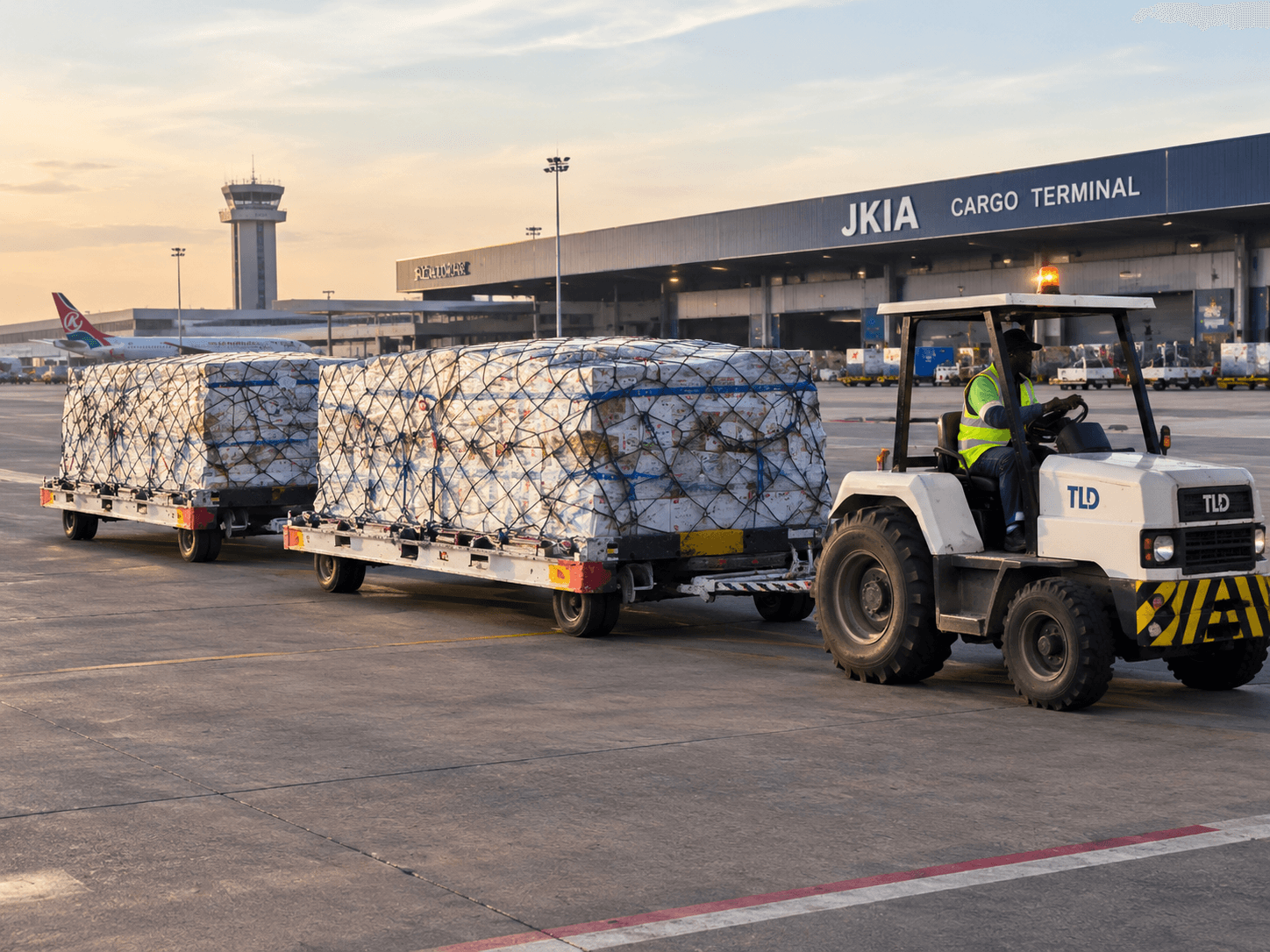
Jomo Kenyatta International Airport (JKIA) has developed into a major cargo hub for Kenyan fresh produce and flowers, with established air-cargo infrastructure supporting the country's export trade. Flowers and other perishables make up a substantial share of Kenya's air cargo exports, which has driven investment in cold-chain-capable cargo handling specifically built around this kind of freight. TrueScent's own location — Agrotronics Building, Freight Road, JKIA — sits within this air-cargo environment.
Why Timing Is Everything
Every hour a flower spends outside cold storage or waiting for onward transport uses up vase life that can't be recovered later — this is a one-way clock, not something that resets. Coordinating harvest, grading, packing and airport arrival tightly around a specific flight is a core part of managing a shipment well, and is one of the clearest ways to tell an experienced exporter from an inexperienced one: the good ones plan backward from the flight, not forward from harvest.
Cargo Preparation and Handover
Cartons are consolidated, weighed and prepared for airline handover with documentation matching the shipment, so cargo can move directly into the freight process without delay at the airport. Any mismatch between documentation and the physical cargo — wrong weights, incomplete paperwork — is a common source of avoidable delay at this stage, which is why documentation accuracy matters as much as the physical handling of the flowers.
Packaging for Air Cargo
Export cartons need to protect stems from physical damage while allowing enough airflow to prevent heat build-up inside a sealed box during the flight — a genuine engineering trade-off, not just a box size decision. See How Fresh Flowers Are Packed for Export for more detail on how this is handled.
Cold-Chain Continuity Through the Airport and Flight
Temperature-controlled handling continues through airport transfer and, where available, temperature-controlled cargo holds, since a break at this stage can undo careful handling earlier in the journey. The handoff points — farm cold storage to transport, transport to airport cold storage, airport cold storage to aircraft — are where cold-chain breaks are most likely to occur if not carefully managed, simply because each handoff involves a change of custody and, often, a change of environment.
Transit and Routing Considerations
Transit time depends on the specific route, whether the shipment is direct or transits through another hub, and current airline schedules — this is confirmed for each shipment rather than fixed in advance or promised as a blanket figure. The destination airport a buyer specifies affects routing options and, in turn, transit time, which is why confirming your preferred arrival airport upfront helps with accurate planning.
Factors That Affect Freight Cost
| Factor | Why it matters |
|---|---|
| Chargeable weight | Priced on the greater of actual weight or volumetric (dimensional) weight — carton dimensions and packing density both matter |
| Routing | Direct routes vs. routes transiting another hub affect both cost and transit time |
| Seasonal demand | Cargo capacity tightens around peak gifting periods, which can affect both space and pricing |
| Shipment frequency | Recurring, scheduled shipments generally allow more predictable freight planning than one-off orders |
| Destination airport | Different arrival airports can mean different routing options and cost structures |
Factors That Can Affect Flower Quality During Transportation
- Time outside cold storage at any handoff point, however brief, draws down vase life that can't be recovered.
- Delays — whether at consolidation, customs, or awaiting cargo space — extend the time a shipment spends in transit conditions rather than controlled storage.
- Rough handling during loading or transfer can cause physical damage that isn't always visible until the flowers are unpacked.
- Packaging mismatched to the flower type or journey length can allow either physical damage or heat build-up inside the carton.
- Poor pre-flight hydration and cold-chain preparation means a shipment starts the journey already behind, regardless of how well the flight itself goes.
Importer Preparation at Destination
Buyer-side readiness matters as much as anything done in Kenya. Before your first shipment arrives, it's worth having in place: a cleared customs and import process appropriate to your market, transport arranged from the airport to your facility, and cold storage ready to receive the shipment immediately on arrival. The faster a shipment returns to cold storage after landing, the more of its remaining vase life is preserved.
What Information to Provide When Requesting Freight-Inclusive Pricing
To quote accurately on a freight-inclusive basis, we typically need: flower and variety, quantity, packaging format, destination country and airport, required delivery date, and order frequency (one-time or recurring). Providing this upfront speeds up an accurate quotation and avoids back-and-forth before a shipment can be planned.
This is educational context rather than a quote on specific airlines or freight rates — actual routing, carrier and pricing are confirmed per shipment, and TrueScent does not claim or imply airline partnerships beyond the freight capacity available through JKIA's cargo market at the time of booking. See our export process page for how air freight fits into the wider journey from farm to destination.
Frequently Asked Questions
Why don't fresh flowers travel by sea freight?
Sea freight transit times are simply too long for a product with a vase life measured in days to weeks. Air freight compresses the farm-to-buyer window to a day or two in many cases, preserving far more usable vase life on arrival.
What is "chargeable weight" in air freight pricing?
Air freight is typically priced on chargeable weight, which accounts for both actual weight and volumetric (dimensional) weight — whichever is greater. Carton dimensions and packing density both factor into this calculation.
What information do I need to provide for a freight-inclusive quote?
To quote accurately on a freight-inclusive basis, we typically need flower and variety, quantity, packaging format, destination country and airport, required delivery date, and order frequency (one-time or recurring).
Does the cold chain continue during the flight itself?
Temperature-controlled handling continues through airport transfer and, where available, temperature-controlled cargo holds, since a break at this stage can undo careful handling earlier in the journey.
How far in advance should I book air freight for an event with a fixed date?
Because freight capacity and routing can shift, buyers planning around a fixed date should confirm shipment details well ahead of time rather than close to the date needed.
What should I have ready at destination before my first shipment lands?
A cleared import process for your market, transport arranged from the airport, and cold storage ready to receive the shipment immediately — the faster a shipment returns to cold storage after landing, the more remaining vase life is preserved.
Related Reading
- Flower Export From Kenya: From Farm to International Buyer
- How Fresh Flowers Are Packed for Export
- Flower Quality and Cold Chain
Ready to plan a shipment? Request an Export Quote.
Ready to Source Kenyan Flowers?
Tell us your flower, specifications and destination — our export team will confirm availability.
Related Articles

Quality & LogisticsSeptember 20264 min read
How Fresh Flowers Are Packed for Export
Export packaging has to do two competing jobs at once — protect stems from damage and keep air moving to prevent heat build-up.
Read article →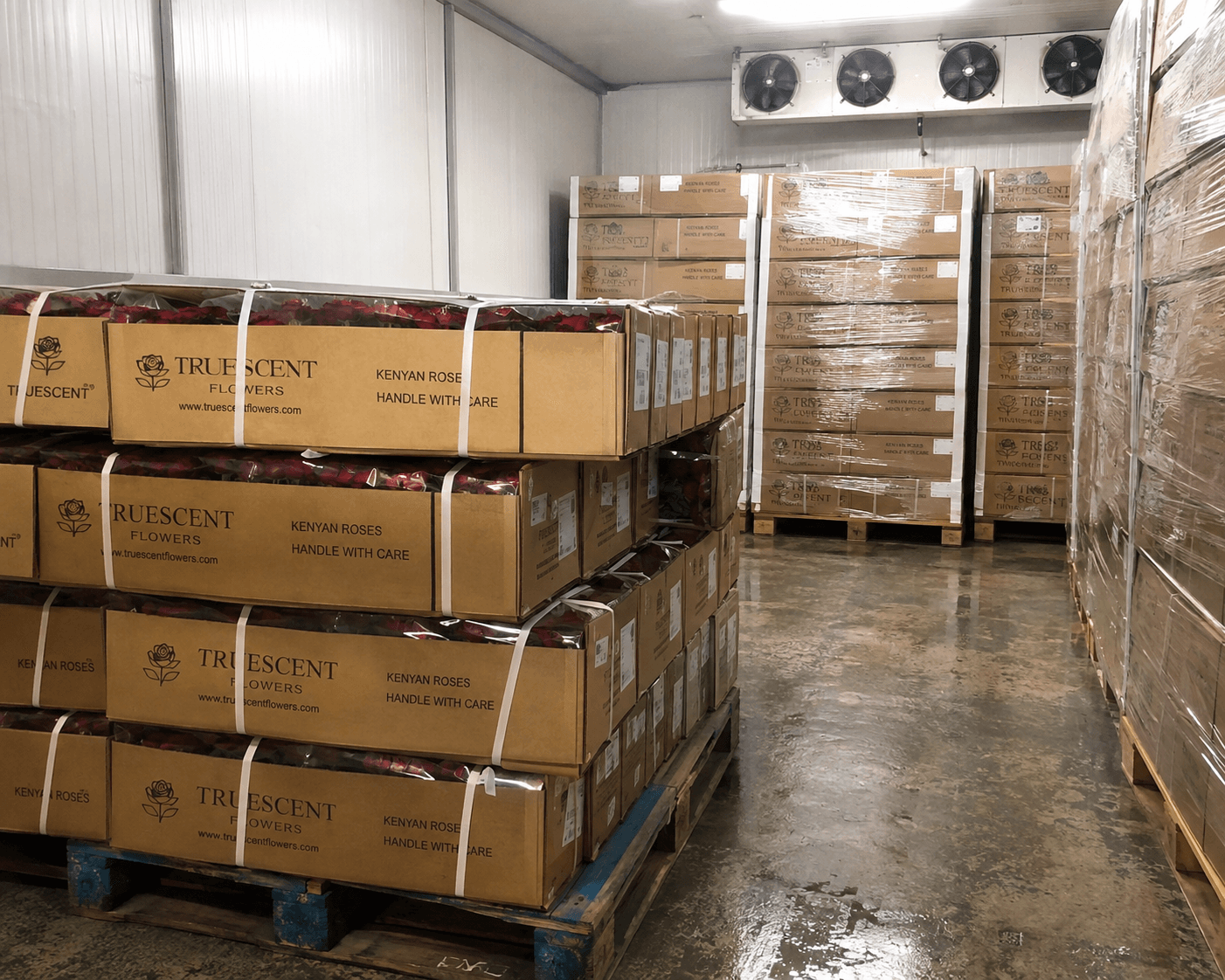
Quality & LogisticsSeptember 20268 min read
Flower Quality and Cold Chain: From Kenyan Farm to International Buyer
Why temperature control is the single biggest factor in flower freshness, and how it's maintained at every stage from Kenyan farm to international buyer.
Read article →Quality & LogisticsAugust 20265 min read
How to Maintain Freshness During Flower Transportation
From harvest to delivery, several handling steps determine how fresh flowers arrive at their destination.
Read article →