
Why Kenya?
One of the World's Leading Flower-Growing Regions
Kenya's position as a major flower exporter isn't accidental — it comes down to a specific combination of geography, climate and grower expertise built up over decades.
Where Kenya's Flowers Are Grown
Kenya's flower farms cluster around the Rift Valley and the high-altitude slopes of Mount Kenya, where equatorial sunlight and cool nights meet.
Commercial flower growing in Kenya is concentrated in a handful of highland districts rather than spread evenly across the country — each shaped by its own combination of altitude, lake-moderated microclimate or proximity to Mount Kenya. Naivasha remains the country's best-known flower-growing district by scale, while Nakuru, Nanyuki, Timau and the wider Mount Kenya region each bring their own altitude and temperature profile to the varieties grown there.
Map of Kenya's flower-growing highland regions: Nakuru, Naivasha, Timau, Nanyuki and the Mount Kenya region
Nakuru
On the Rift Valley floor around Lake Nakuru, an established rose-growing area with decades of commercial flower farming behind it.
Naivasha
Kenya's largest concentration of flower farms, clustered around Lake Naivasha at roughly 1,880m above sea level — the country's best-known flower-growing district.
Timau
High on the northern slopes of Mount Kenya, where altitude and cool nights suit slower, more deliberate flower growth.
Nanyuki
Sitting almost on the equator at the base of Mount Kenya, combining consistent day-length with cool overnight temperatures.
Mount Kenya Region
Equatorial highlands above 1,800m circling Mount Kenya, among the highest-altitude flower-growing areas in the country.
Ideal Equatorial Climate
Kenya sits almost exactly on the equator, giving growing regions consistent day length year-round. This stability, combined with strong, direct sunlight, supports steady, predictable growing cycles rather than the sharp seasonal swings seen in temperate flower-growing countries.
High-Altitude Growing Regions
Much of Kenya's flower production takes place at elevations between 1,500 and 2,500 metres above sea level. At this altitude, nights are cool even though the country sits on the equator — and that cool-night, high-light combination is widely credited with producing stronger stems, deeper colour saturation and denser petal structure.
Exceptional Flower Quality
The combination of altitude, light and temperature gives Kenyan-grown flowers a reputation for consistent, export-grade quality — a major reason Kenya has grown into one of the world's leading cut flower exporters.
Long Vase Life
Flowers grown under cooler, high-altitude conditions generally respire more slowly, which is associated with longer post-harvest vase life — an important quality marker for buyers further down the supply chain.
Experienced Growers
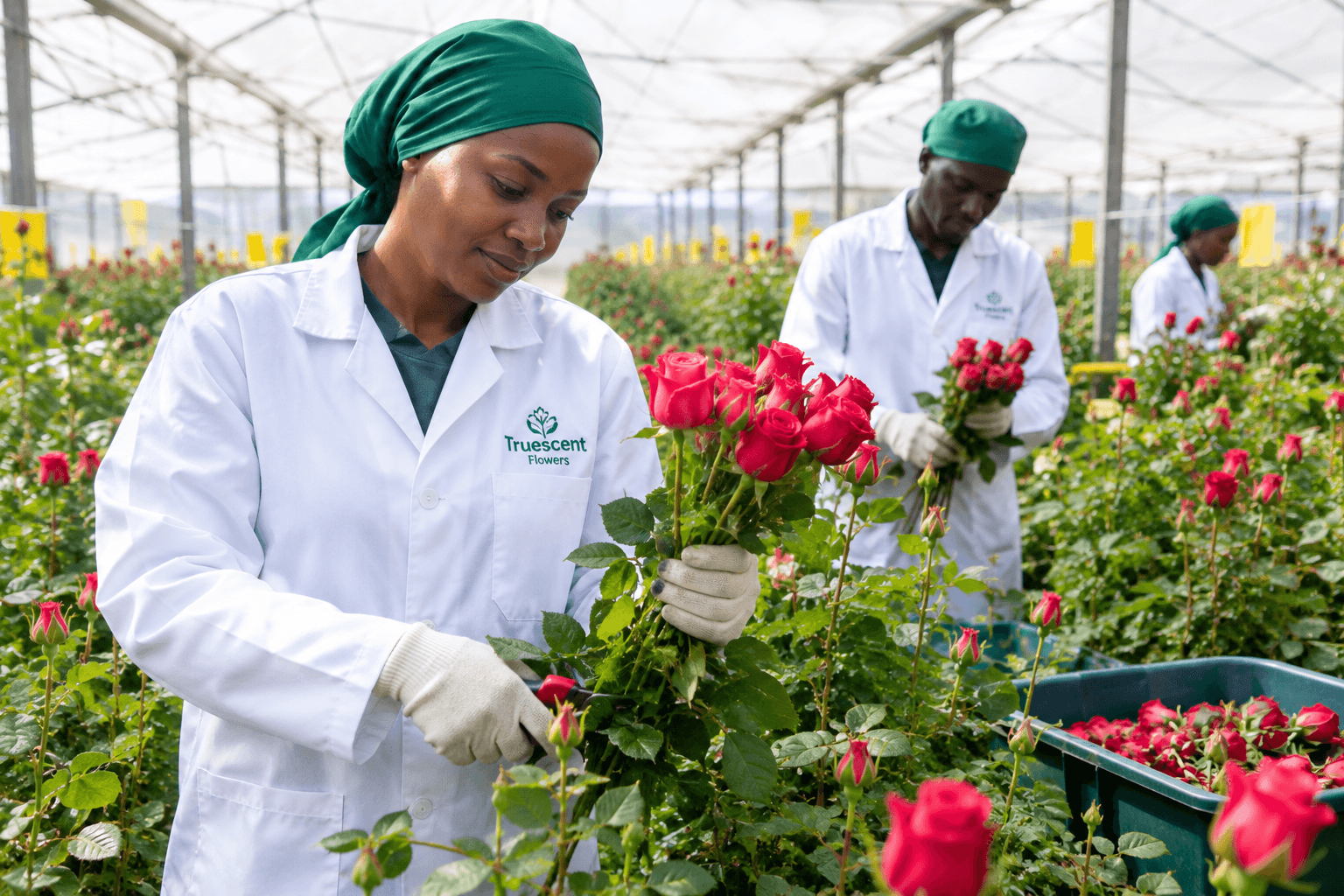
Kenya's flower sector has built decades of expertise in greenhouse growing, grading and post-harvest handling, supported by a large, experienced workforce across the growing regions.
Strong Export Infrastructure
Established cold chain, packing and logistics infrastructure connects Kenyan farms to Nairobi's Jomo Kenyatta International Airport, one of Africa's major air cargo hubs for fresh produce and flowers.
Internationally Recognised Production Standards
Kenya's flower sector operates within internationally recognised production and phytosanitary frameworks, supporting compliance with the import requirements of major destination markets.